All Categories
Featured
Why Switch Towards Eco-Friendly Business Landscaping?
Best Practices for Southern California Grounds Management

How to Convert to Native Planting Successfully
Table of Contents
It is a regular website for ongoing student and professors driven remediation jobs.
The as soon as magnificent Stone Canyon Creek was formerly a dominant feature of the UCLA campus. However throughout the years, as the campus expanded, the creek was routed underground and now just this small segment runs behind the Anderson School of Management. Volunteers continue to remove invasive plants, replant the area with native greenery, and restore the ecosystem.
You can find out more about Stone Canyon Creek Repair on this page. On the south of school, the Mildred E. Mathias Botanical Garden (MEMBG) is a living museum, having special collections created to help the undergraduate teaching mission at UCLA and to enhance the ability for research on campus.
This facility provides its academic content to the school community, homeowners of Los Angeles, and visitors from around the world to boost learning more about plants and promote higher gratitude for importance of plants to society. Not far from the arboretum, near the Court of Sciences is a location between Franz Hall and Geology fondly called "Hummingbird Alley" or "Hummingbird Canyon.
Preparing for 2026 Sustainability Benchmarks for Southern California
She began feeding hummingbirds from her office and the population grew to a nest of 200 plus birds. When Melanie left UCLA and the feeder project ended, trainees in the Bruin Birding Club got a grant from the Audubon Plants for Birds program to remove ivy and plant native pollinator encouraging plants in the location to develop more environment for the hummingbirds.
In the Santa Monica Mountains, the La Kretz Field Station is an unique, collective task in between the UCLA La Kretz Center and the National Forest Service. The area is perfect for facilitating students and visitors alike to work on collaborative preservation jobs in the Santa Monica Mountains and across Southern California.
The La Kretz Center for Preservation Science assists maintain California's biodiversity and communities through research, education and public programs. They supply the scientific research needed to notify management actions to protect and bring back California's delicate biodiversity resources. In the Owens Valley, UCLA Handles the White Mountains Research Study Center, which consists of 4 research study stations situated along a 10,000-foot elevational gradient.
Securing SoCal Portfolio Landscapes for Drought
Surrounded by semiarid scrubland and riparian forest, it provides a base for year-round research in the region. Roughly 6,000 feet higher and 1.5 hours of driving time away are the log walls of Crooked Creek Station, sited in the middle of montane woodland and sagebrush hills. Close-by grow two groves of bristlecone pine that include the oldest trees in the world.
Trending CitiesPhoenix, AZ Landscape DesignTucson, AZ Landscape DesignHuntington Beach, CA Landscape DesignLos Angeles, CA Landscape DesignMill Valley, CA Landscape DesignNapa Valley, CA Landscape DesignOakland, CA Landscape DesignPalo Alto, CA Landscape DesignSacramento, CA Landscape DesignSan Diego, CA Landscape DesignSan Jose, CA Landscape DesignSan Francisco, CA Landscape DesignThousand Oaks, CA Landscape DesignVentura, CA Landscape DesignAurora, CO Landscape DesignDenver, CO Landscape DesignLakewood, CO Landscape DesignBridgeport, CT Landscape DesignGreenwich, CT Landscape DesignNew Canaan, CT Landscape DesignStamford, CT Landscape DesignWashington, DC Landscape DesignMiami, FL Landscape DesignOrlando, FL Landscape DesignPalm Beach, FL Landscape DesignTampa, FL Landscape DesignWinter Park, FL Landscape DesignAtlanta, GA Landscape DesignRoswell, GA Landscape DesignTwin Falls, ID Landscape DesignJoliet, IL Landscape DesignBoston, MA Landscape DesignCambridge, MA Landscape DesignPotomac, MD Landscape DesignPortland, ME Landscape DesignSt.
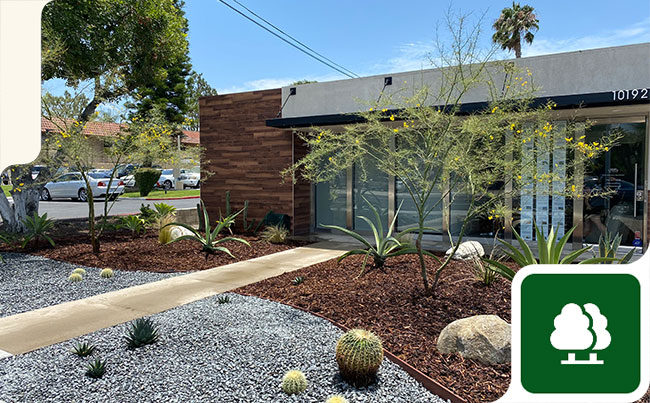
As part of its dedication to conserving water, Caltech has actually transformed almost a quarter of its school to drought-tolerant landscaping and instituted systems to recover condensate from building air-conditioning systems to fill up reflecting pools. California native plants and other drought-tolerant plants cover 17 percent of campus, up from 4 percent in 2012.
Exceeding Sustainability Standards for Southern California
Every square foot of turf changed conserves 20 gallons of water per year usually. As an outcome of these efforts, irrigation accounts for less than ten percent of Caltech's water usage in a typical year. While these landscaping efforts to minimize irrigation requirements would usually solve most of a water user's obstacles, Caltech's water difficulties are more intricate.
That matters, considered that the energy plants represent about half of the water utilized on campus in a typical year.
This site describes how to create and set up California friendly landscaping, watering methods and equipment that will help you water your landscape more efficiently, and suggestions on how to quickly and successfully maintain your garden. Please click Lawn to Garden for examples of gardens that consist of style parts that are turf refund eligible.
2004-2025 Jadene Mayla, All Rights Reserved.
Local Service Center Standards for Southern California
"Sustainable landscapes are responsive to the environment, re-generative, and can actively contribute to the development of healthy neighborhoods. - From the American Society of Landscape Architects WE CAN SIGNIFICANTLY REDUCE YOUR LANDSCAPES WATER AND ENERGY USE, WHILE DEVELOPING A MORE LUSH, BEAUTIFUL, AND ENVIRONMENTALLY SUSTAINABLE GARDEN SPACE FOR YOU AND YOUR HOUSEHOLD TO ENJOY!
We utilize just the most efficient water-saving and lighting technology in our designs that require just a fraction of the water and energy that older systems use. CBL create habitat for regional and migratory bird in addition to helpful insect populations. We mostly uses organic fertilizers and mulches in our designs and starts non-toxic insect control programs for all our jobs.
Landscape MaintenanceIt is our objective to produce outside areas that are gorgeous and dynamic, that need little water and energy, are healthy and happy spaces for our customers to enjoy, which likewise supply practical benefits to our regional environment.
Raptors (e.g. hawks, owls, falcons) are big, charming bird types at the top of the food cycle. They experienced human-driven population crashes throughout the 19th and 20th centuries. While a subset of these species has actually recovered in the Los Angeles area, others have not and are intolerant of urbanization and other human activities.
Navigating 2026 Sustainability Benchmarks in SoCal
Nesting areas of raptors are also important signs of community health in metropolitan areas like the Los Angeles area. Several federal government companies, designers and not-for-profit organizations gather information on urban-nesting raptors around the Los Angeles Basin, but these efforts are not well-coordinated. If this info can be combined, it will be beneficial to producing management tools like maps and databases that can assist direct regional policy and land-use choices.

Latest Posts
Why Switch Towards Eco-Friendly Business Landscaping?
Best Practices for Southern California Grounds Management
Why Reliable Care Matters for Public Safety